Education for all: Credential College expands with new partnership

Savannah Behrends
Copywriter and features editor | March 17, 2026




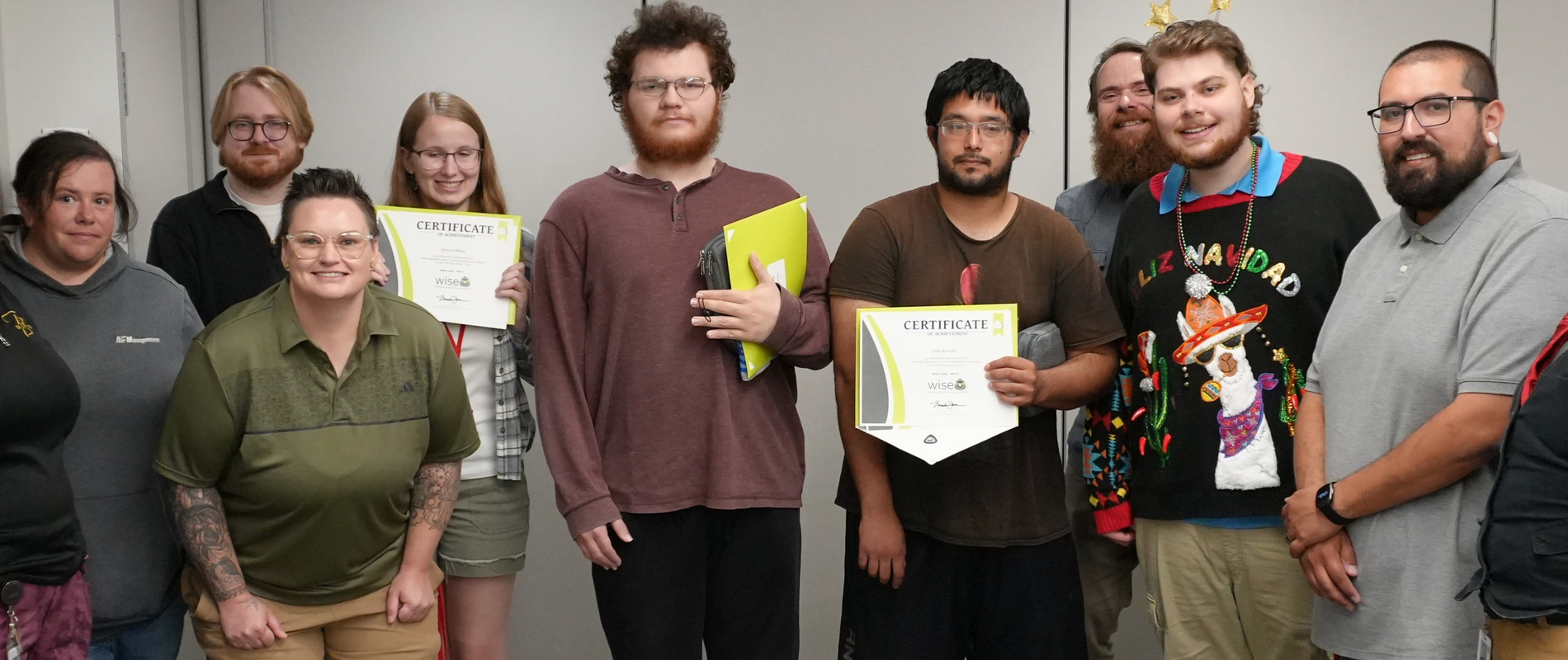
Standing in front of a packed room at the Munroe-Meyer Institute (MMI) last May, iFixAmerica founder and CEO Jason DeWater’s eyes welled with tears as he addressed four Mobile Device Repair Academy Wireless Industry Service Excellence (WISE) Level 1 graduates.
“Your potential is going to change the industry. I’m so proud of you,” he said.
The students — Drew Curphey, Adyson Sandoval, Emmy Miller and Jose Arriola — were a part of the first MMI Trailblazer Academy collaboration with the Metropolitan Community College Credential College and iFixAmerica. The Trailblazer Academy offers tailored educational programs to young adults between the ages of 18-25 who have mild to moderate intellectual disabilities.
The partnership is an expansion of Credential College, an initiative that provides entry-level credentials to the nearly 40% of Nebraska high school graduates who self-identify as not intending to pursue a traditional four-year college degree after finishing secondary education.
“It’s about getting good jobs, not necessarily a full degree,” said Gary Girard, vice president of Community and Workforce Education.
Credential College began three years ago when Girard and MCC Associate Vice President for Workforce Education Todd Hansen reached out to iFixAmerica founder Jason DeWater with an idea to bring the Mobile Device Repair Academy to Keith Lutz Horizon High School, an alternative school in the Millard Public Schools district.
Horizon was selected because of its nontraditional student population that ranges from 150-180 students. The school provides additional support services to students, such as a credit recovery program and behavioral counseling.
The first cohort saw 15 students successfully complete the WISE Level 1 and Level 2 certifications. A second pilot focused on the information technology-based CompTIA program at Millard North, which graduated with six students in the first cohort.
“We thought we were going to place them into a job, but they all wanted to come to MCC and continue their education,” Girard said. “It lit a fire.”
Unlocking potential serving new student populations
With the success of the first two cohorts, Girard’s team began considering what other student populations might be reached. That’s when Rachel Ray from MMI reached out.
MMI is a division of the University of Nebraska Medical Center and houses the University Center for Excellence in Developmental Disabilities, a special designation for academic centers that support individuals with developmental disabilities in attaining independence.
Ray, who is the director of the MMI-UNO Trailblazer program, said MMI had been looking for a workforce skills training partner since 2015.
“We finally found the right partner and the right program with MCC,” she said.
“Sometimes when you talk about these kinds of collaborations, especially for students with intellectual and developmental disabilities, folks wonder if [the students] are able to do this. [The MCC team’s] passion, commitment and willingness to give individuals with intellectual disabilities a chance, and to trust that they can do the work, made MCC the perfect partner.”
Flexibility in repair
The four MMI students were enrolled in an adapted five-week Mobile Device Repair Academy to receive the WISE Level 1 certification. Traditionally, the Mobile Device Repair Academy takes place over five, eight-hour days to achieve the WISE Level 1 and 2 certifications and is followed by an internship.
“That’s a long time to stay engaged for anybody,” Ray said. “We wanted to make sure students understood the information before we moved on.”
Level 1 curriculum covers foundational knowledge, from inspecting and testing basic functionality to determining user error.
DeWater said that the coursework is rigorous and assessments are “hard as nails.” So hard, in fact, that after writing and testing the first assessment DeWater found that even he was challenged.
“The morning before class I took the assessment myself quickly and submitted it. I scored an 86 on it and found that I had made a silly mistake. I wrote the test and I still couldn’t ace it,” DeWater said.
However, all four students scored 100, proving that they were not only learning the information, but retaining it perfectly. As DeWater passed out the certificates, he was emotional about the students’ achievements. Students left the ceremony with confidence in their newly learned skills.
“It’s a nice feeling knowing I can help someone fix something that’s broken,” Arriola said.
During the WISE 1 certificate ceremony, students were gifted a tool set they’ll be able to use during the WISE 2 certificate course, which teaches device disassembly and repair.
“If you show me a technician that can disassemble a modern iPhone to its bare components and reassemble that phone to working condition, then I can show you a technician that can fix any appliance — anything with a chip in it,” DeWater said.
This partnership have proven that education is for everyone — it just takes the right program and the right support system.
“At MCC, we’re in communities to educate all learners, from 5 to 85 and older,” Hansen said. “We’re here for everybody.”
Visit mccneb.edu/CredentialCollege to learn about accelerated pathways to in-demand jobs